
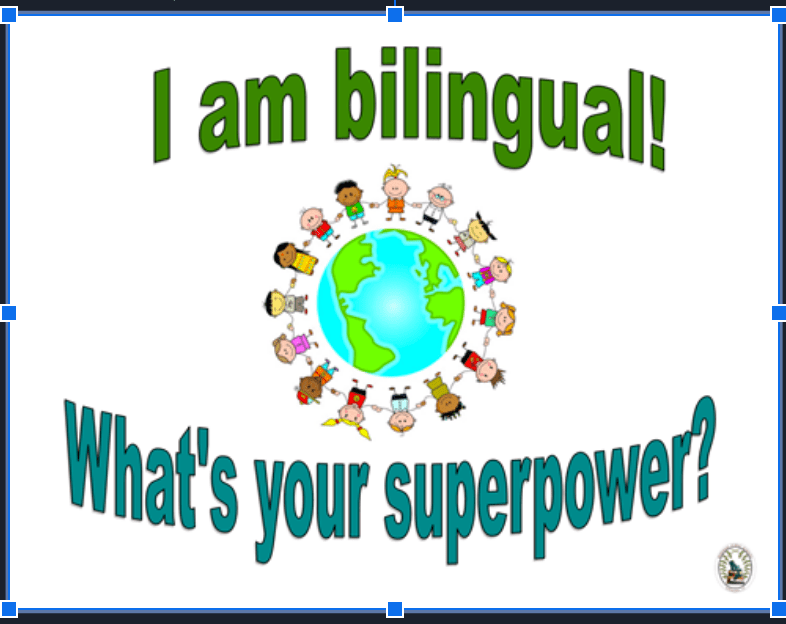
April is National Bilingual/Multilingual Learner Advocacy Month.
For too long, our Emergent Bilingual and Emergent Multilingual students have been treated as less than in our classrooms. Known as English Learners throughout the country, the education system has focused on what students lack rather than what students bring to the classroom, and these supposed deficiencies have been meant to be “remedied.” Even today, many schools try to compensate for students’ lack of English by coddling them and not providing students rigorous academic instruction that promotes both their entire linguistic prowess and their academic growth in all their languages, let alone in English. “They’ve gone through trauma,” I’ve been told many times. Let’s make this clear… growing up with a language other than English is not a trauma!
Instead, it is time to celebrate our students’ multilingualism. Our students are bringing into the classroom rich cultures that are embedded in their language. Their knowledge of food, religion, and cultural expectations far surpass the knowledge of those who are monolingual. Furthermore, embedded in language are ideas that often do not even exist in all languages. For example, the word despreciar in Spanish is translated poorly in Google Translate as “despise,” but those who are bilingual know that there is so much more to the word that cannot be fully expressed in English. Similarly, the word runu in Tamil is a concept loosely referring to the heavenly ties amongst all people on earth and is used to explain both long lasting relationships and relationships that come to an end. This word exists in languages such as Japanese but not in English, and therefore, thoughts associated with this word cannot be had in English. Hence, students who come to us speaking Languages Other Than English (LOTE) are coming with thoughts that English speakers cannot even have, and their richness in thoughts and concepts will only be amplified as their linguistic prowess in both languages grows.
So how can we celebrate our Emergent Bilingual and Multilingual students? Here are just a few ideas:
- Have students create posters that state, “Bilingualism is my superpower. What’s yours?” to hang around the school. Make sure that all students who speak a LOTE are able to participate and that the posters are made in all the languages represented at your school. Do not forget low incidence languages. All bilingualism and multilingualism count!
- Have students research information about the many different languages in the world. It will lead students to learn that there are over 7,000 languages spoken in the world and that there are 23 major languages. Have students research some of the endangered languages, revival efforts of dying languages, and the importance of multilingualism. By realizing how diverse the world really is, students can see how important multilingualism really is.
- Have students who speak another language and who want to participate share with the class something about their culture. Even if all of your students speak the same language, there will likely be differences in their culture depending on the countries their families are from or even the region. Reward students for presenting with extra credit, more time at recess, etc. Remember, it is not their responsibility to educate us.
- Host a school-wide essay or art competition at your school with the theme, “Why Bilingualism is Important to Me.” Have students participate after having a brainstorm session with them about bilingualism. (Use the opportunity to teach about essay writing as well or get younger students to write a sentence with their pictures.)
- Bring in guest speakers who can talk about how bilingualism has benefitted them both personally and professionally. Try to bring in speakers from different linguistic backgrounds and different professions. If at all possible, make sure monolingual staff are also present at these assemblies. After the guest speaker leaves, review with students why bilingualism is important.
*Bonus: Have students (who are old enough) write their legislators asking for more support for Dual Language and World Language programs. Advocacy is the best way to celebrate! And it is National Bilingual/Multilingual Learner Advocacy Month.
These are just a few ways that you can celebrate bilingualism and multilingualism at your school. Share other ways that you are celebrating bilingualism this month.
 Language and Equity Blog