
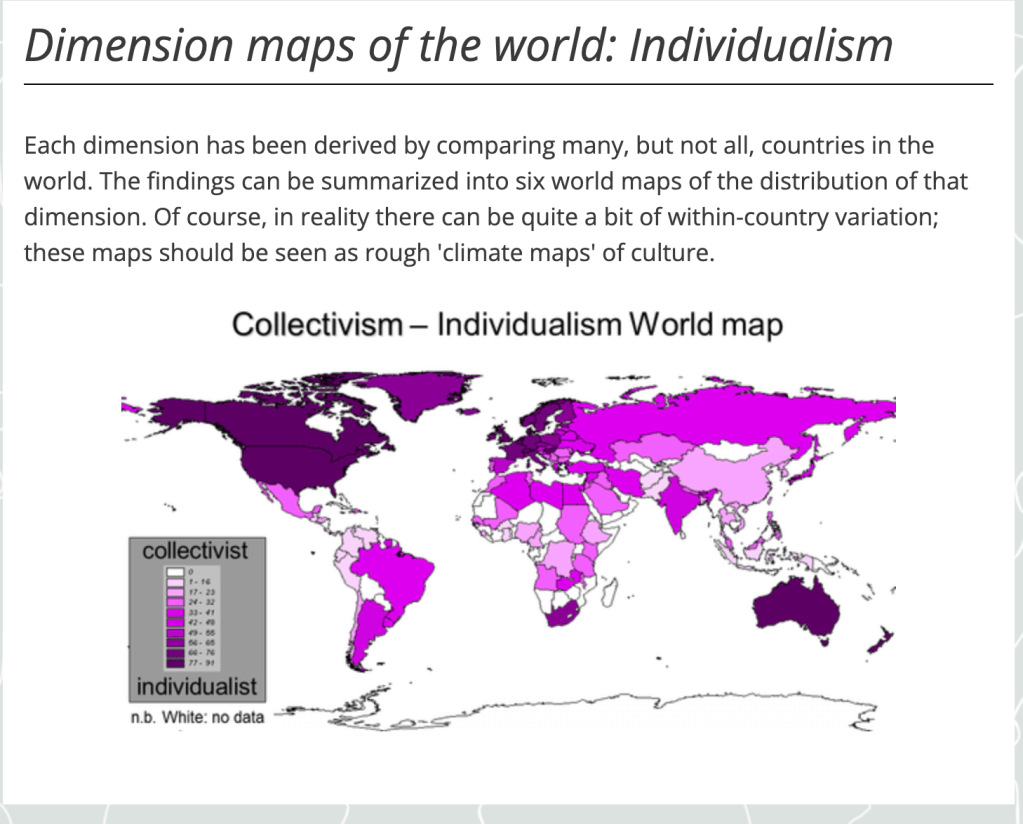
The Map Above Comes from Geert Hofstede Website
One of the latest arguments highlighted by social media lately has been an argument over Zohran Mamdani’s use of the phrase, “warmth of collectivism.” Mamdani has proclaimed that voters have asked for collectivism over individualism. On the other hand, prominent commentators and religious figures have decried the idea of collectivism. For example, Bishop Barron has claimed that “collectivism” is against Catholic values, equating the term to socialism.
My blog is not meant to be used for political activism. My opinions on Zohran Mamdani and Bishop Barron are mine, and I won’t be sharing those opinions here. However, as a multilingual educator, I am concerned that we are trying to place a value system on cultural traits that define our students’ and their families’ backgrounds.
First, let’s define both collectivism and individualism. Geert Hofstede (1980) in his cultural dimensions theory determined 6 spectrums that he labeled as dimensions. These dimensions describe how individuals within societies relate to one another. Collectivism and individualism are two extremes of one of those spectrums.
Collectivist and individualistic societies differ based on how they see the primary unit of society. Collectivists see the social group as the primary unit, thereby the individual is seen in relation to the larger group whether that be an institution, a town, or a country. Individuals in collectivist societies are more likely to sacrifice their own happiness for the sake of the social group. On the other hand, in individualistic societies, the individual is seen as the primary unit and is encouraged to pursue their own happiness (and sometimes that of their nuclear family) over all else.
Overall, northern and western European countries and countries that model their cultures after them such as the United States, Canada, and Australia tend to be more individualistic than collectivist. In fact, according to Hofstede’s Globe, the United States, as a whole, has the highest score for individualism (91 on a scale of 1-100). On the other hand, Guatemala has the lowest score (9 on a scale of 1-100). Other countries fall somewhere in between.
It is important to note that Hofstede never assigned a value judgement to either extreme of the spectrum. Instead, the individualistic-collectivist cultural dimension should be used as a tool to understand one another and for us, as teachers, to understand our students. For instance, in our multilingual classes, many of our students will identify with collectivist cultures, and all will identify with cultures less individualistic than how the United States, as a whole, scores. Therefore, many of our students will be more likely to prefer team work when learning. They will be more likely to help a student who is struggling and be more talkative when working, even when the task is meant to be individual work. Shame is a greater phenomenon in collectivist societies, and students are much more aware of status. Therefore, they are more likely to defer to authority figures. Furthermore, parents may see their jobs as raising productive members of society rather than as raising independent individuals. Extended families or at least kids living at home until marriage are likely more accepted or even the norm.
On the other hand, students from individualistic cultures will likely be driven more by competition than by team work. They will also talk but expect to be heard as individuals rather than as a voice within the fold. They expect respect from adults as well as their classmates. Parents expect their children to leave home at 18 and see the purpose of parenting as raising their kids to be independent.
By understanding these differences, we, as educators, can see that the child who is helping a struggling student during an exam is not trying to cheat but is trying to do their job of helping a weaker member of society. We can see that teasing an older student from a collectivist culture in front of classmates may make the child feel less than in comparison to a student from an individualistic society who may give it right back to the teacher in a friendly jest.
Of course, because the dimension is a spectrum, we cannot automatically assume how a student will always react. Furthermore, students will be engaged in transcultural acculturation and thereby, eventually finding their sweet spot on the spectrum, likely somewhere between where their culture scores and their surrounding culture scores. But the collectivist-individualistic dimension provides us a lens to understand our students’ behaviors. And that’s way more important than getting into a war over semantics.
 Language and Equity Blog